Strain Hardening Behavior of Engineered Cementitious/Geopolymer Composites Under Sulfuric Acid Erosion
DOI:
https://doi.org/10.56748/ejse.24878Keywords:
Engineered geopolymer composites, durability properties, sulfuric acid, tensile performance, deflection-hardening behavior, microstructural analysisAbstract
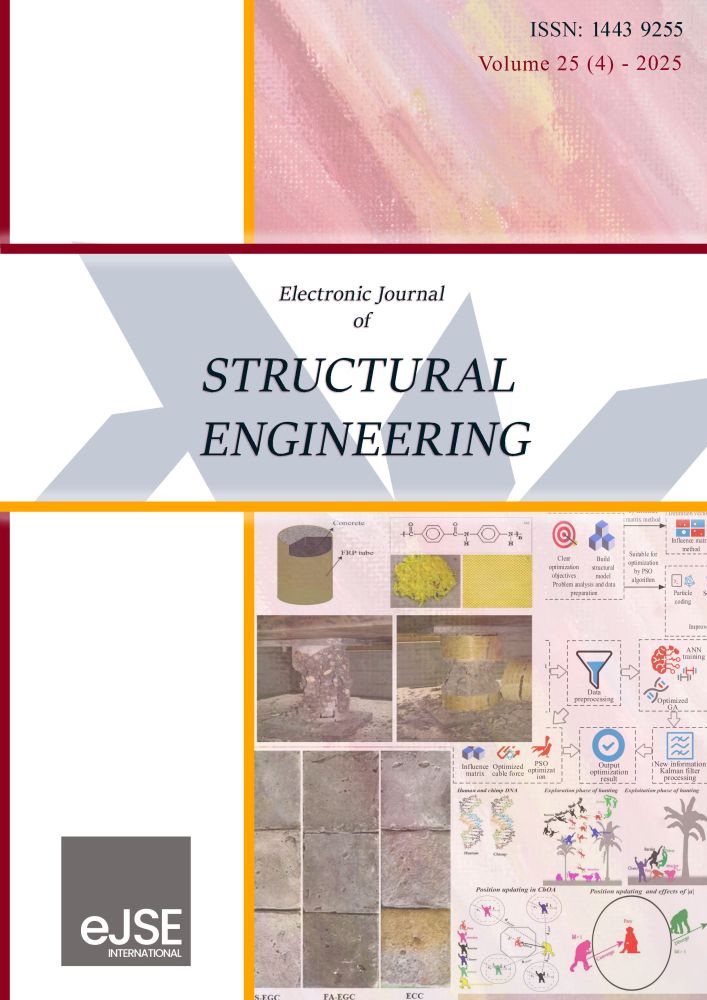
This study presents a comparative durability assessment of Engineered Geopolymer Composites (EGCs) against a Engineered Cementitious Composite (ECC) under prolonged sulfuric acid (H₂SO₄) attack. This work addresses a critical gap by systematically comparing the strain-hardening performance and degradation mechanisms of lightweight fiber-reinforced composites under aggressive chemical exposure. Four lightweight mixtures—three EGCs with varying slag/fly ash contents (S-EGC: 100% slag; FAS-EGC: 50% slag; FA-EGC: 100% fly ash) and one lightweight ECC control—were fabricated using expanded glass granule (EGG) aggregates and immersed in a 5% H₂SO₄ solution for up to 120 days. Before exposure, the incorporation of slag significantly enhanced pre-exposure mechanical properties; S-EGC showed the highest ultimate strength, while the FAS-EGC mixture provided the best balance of strength and ductility, achieving a tensile strain capacity of 3.21%. The lightweight EGCs demonstrated superior acid resistance compared to the lightweight ECC. After 120 days of exposure, the S-EGC composite retained the highest residual compressive strength (81.59%), while the ECC retained significantly less. Significantly, all exposed EGC and ECC specimens maintained their multiple cracking and deflection-hardening behavior, retaining approximately 50% of their total deflection capacity after four months. Microstructural analysis confirmed that the superior resistance of S-EGC is attributed to its stable, cross-linked alumino-silicate polymer structure. These findings confirm that lightweight slag-based EGCs are a highly durable and ductile sustainable alternative for structural applications in aggressive environmental settings, such as wastewater treatment infrastructure and chemical plants.
Downloads
References
Abdulhaleem, Khamees N et al. 2025. “A Comprehensive Review of Sustainable Geopolymer Concrete Using Palm Oil Clinker: Environmental and Engineering Aspects.” Energy Science & Engineering.
Abed, Mukhtar Hamid, Israa Sabbar Abbas, Majid Hamed, and Hanifi Canakci. 2022. “Rheological, Fresh, and Mechanical Properties of Mechanochemically Activated Geopolymer Grout: A Comparative Study with Conventionally Activated Geopolymer Grout.” Construction and Building Materials 322: 126338.
ACI Committee 211. 1998. “ACI 211.4R-93 Guide for Selecting Proportions for High-Strength Concrete with Portland Cement and Fly Ash.” Manual of Concrete Practice 93(Reapproved): 13.
ACI Committee 544, 2009. ACI 544.2R-89: Measurement of Properties of Fiber Reinforced Concrete (Reapproved 2009). American Concrete Institute, Farmington Hills, MI, USA.
Ahmet Emin Kurtoğlu, Radhwan Alzeebaree, Omar Aljumaili, Anıl Niş, and Ghassan Humur and Abdulkadir Çevik Mehmet Eren Gülşan. 2018. “Mechanical and Durability Properties of Fly Ash and Slag Based Geopolymer Concrete.” Advances in Concrete Construction 6(4): 345–62.
Alaa Mohammedameen; Abdulkadir Çevik; Mehmet Eren Gülşan. 2018. “Mechanical Behavior and Durability of Confined and Unconfined Engineered Cementitious Composite Exposed to Chemical Attack.” Gaziantep University.
Aljanabi, Maysam et al. 2022. “Residual Mechanical Performance of Lightweight Fiber-Reinforced Geopolymer Mortar Composites Incorporating Expanded Clay after Elevated Temperatures.” Journal of Composite Materials 56(11): 1737–52.
Alzeebaree, R. et al. 2019. “Mechanical Properties and Durability of Unconfined and Confined Geopolymer Concrete with Fiber Reinforced Polymers Exposed to Sulfuric Acid.” Construction and Building Materials 215.
Alzeebaree, Radhwan et al. 2019. “Mechanical Properties and Durability of Unconfined and Confined Geopolymer Concrete with Fiber Reinforced Polymers Exposed to Sulfuric Acid.” Construction and Building Materials 215: 1015–32.
ASTM, 2019. ASTM C1609/C1609M-19: Standard Test Method for Flexural Performance of Fiber-Reinforced Concrete (Using Beam with Third-Point Loading). ASTM International, West Conshohocken, PA, USA.
Bakharev, T. 2005. “Resistance of Geopolymer Materials to Acid Attack.” Cement and Concrete Research 35(4): 658–70.
Chi, Maochieh, and Ran Huang. 2013. “Binding Mechanism and Properties of Alkali-Activated Fly Ash/Slag Mortars.” Construction and Building Materials 40: 291–98.
Criado, Maria, Willian Aperador, and Isabel Sobrados. 2016. “Microstructural and Mechanical Properties of Alkali Activated Colombian Raw Materials.” Materials 9(3): 158.
Fang, Guohao, Wing Kei Ho, Wenlin Tu, and Mingzhong Zhang. 2018. “Workability and Mechanical Properties of Alkali-Activated Fly Ash-Slag Concrete Cured at Ambient Temperature.” Construction and Building Materials 172: 476–87.
Gülcsan, Mehmet Eren et al. 2019. “Development of Fly Ash/Slag Based Self-Compacting Geopolymer Concrete Using Nano-Silica and Steel Fiber.” Construction and Building Materials 211: 271–83.
Gülşan, Mehmet Eren et al. 2018. “Effects of Sulphuric Acid on Mechanical and Durability Properties of ECC Confined by FRP Fabrics.” Advances in Concrete Construction 2(6): 199–220.
Güneş, Muhammet, Hatice Öznur Öz, and Hasan Erhan Yücel. 2024. “The Properties of High-Ductility Engineered Geopolymer Composites Developed with Different Design Parameters.” European Journal of Environmental and Civil Engineering: 1–25.
Hardjito, Djwantoro, and B Vijaya Rangan. 2005. “Development and Properties of Low-Calcium Fly Ash-Based Geopolymer Concrete.”
Hardjito, Djwantoro, Steenie E Wallah, Dody M J Sumajouw, and B Vijaya Rangan. 2004. “On the Development of Fly Ash-Based Geopolymer Concrete.” Materials Journal 101(6): 467–72.
Hu, Wei-Hsiu. 2023. “Decarbonization of Engineered Cementitious Composites (ECC).”
Humur, Ghassan, and Abdulkadir Çevik. 2022a. “Effects of Hybrid Fibers and Nanosilica on Mechanical and Durability Properties of Lightweight Engineered Geopolymer Composites Subjected to Cyclic Loading and Heating-Cooling Cycles.” Construction and Building Materials 326(February): 1–33.
Humur, G. and Cevik, A., 2022b. “Mechanical Characterization of Lightweight Engineered Geopolymer Composites Exposed to Elevated Temperatures.” Ceramics International. https://linkinghub.elsevier.com/retrieve/pii/S0272884222002607 (February 17, 2022).
Humur, Ghassan H et al. 2025. “Thermomechanical Properties of Slag-Based Engineered Geopolymer Composite under a Series of Cooling and Heating Cycles.”
Humur, Ghassan Hussein, and Abdulkadir Çevik. 2024. “Magnesium Sulfate Resistance of Strain-Hardening Fiber Reinforced Slag and Fly Ash-Based Engineered Geopolymer Composites.” Arabian Journal for Science and Engineering 49(4): 5909–25.
Japan Society of Civil Engineers. 2008. “Recommendations for Design and Construction of High Performance Fiber Reinforced Cement Composites with Multiple Fine Cracks (HPFRCC ).” Concrete Engineereing Series 82: Testing Method 6-10.
Juenger, M C G, F Winnefeld, J L Provis, and J H Ideker. 2011. “Cement and Concrete Research Advances in Alternative Cementitious Binders.” Cement and Concrete Research 41(12): 1232–43.
Kanda, Tetsushi, and Victor C Li. 1998. “Multiple Cracking Sequence and Saturation in Fiber Reinforced Cementitious Composites.”
Kani, Ebrahim Najafi, Ali Allahverdi, and John L Provis. 2012. “Efflorescence Control in Geopolymer Binders Based on Natural Pozzolan.” Cement and Concrete Composites 34(1): 25–33.
Kurtoglu, A.E., Alzeebaree, R., Aljumaili, O., Nis, A., Gulsan, M.E., Humur, G. and Cevik, A. 2018. “Mechanical and Durability Properties of Fly Ash and Slag Based Geopolymer Concrete.” Advances in Concrete Construction 6(4): 345–62.
Lao, Jian-Cong et al. 2023. “Strain-Hardening Alkali-Activated Fly Ash/Slag Composites with Ultra-High Compressive Strength and Ultra-High Tensile Ductility.” Cement and Concrete Research 165: 107075.
Lao, J. C., Ma, R. Y., Xu, L. Y., Li, Y., Shen, Y. N., Yao, J., ... & Huang, B. T., 2024. “Fly Ash-Dominated High-Strength Engineered/Strain-Hardening Geopolymer Composites (HS-EGC/SHGC): Influence of Alkalinity and Environmental Assessment.” Journal of Cleaner Production 447: 141182.
Lee, N. K., and H. K. Lee. 2016. “Influence of the Slag Content on the Chloride and Sulfuric Acid Resistances of Alkali-Activated Fly Ash/Slag Paste.” Cement and Concrete Composites 72: 168–79.
Lee, W K W, and J S J Van Deventer. 2002. “The Effect of Ionic Contaminants on the Early-Age Properties of Alkali-Activated Fly Ash-Based Cements.” Cement and Concrete Research 32(4): 577–84.
Li, Victor C. 2008. “Engineered Cementitious Composites (ECC) Material, Structural, and Durability Performance.” In Concrete Construction Engineering Handbook, Chapter 24, Ed. E. Nawy, published by CRC Press.
Li, V.C., 2019. Engineered Cementitious Composites (ECC): Bendable Concrete for Sustainable and Resilient Infrastructure. Springer.
Ling, Y., Li, Z., Tan, Y., Yang, B. and Shi, W. 2025. “Mechanical and Microscopic Performance of Engineered Cementitious Composites: Effects of Fly Ash Fineness and Calcium Content.” Journal of Sustainable Cement-Based Materials: pp.1-19.
Ling, Yifeng et al. 2019. “Effect of Slag on the Mechanical Properties and Bond Strength of Fly Ash-Based Engineered Geopolymer Composites.” Composites Part B: Engineering 164: 747–57.
Malhotra, V. M. 1999. “Making Concrete ‘Greener’ With Fly Ash.” Concrete Internationa 21: 61–66.
Mehta, Ankur, and Rafat Siddique. 2017. “Sulfuric Acid Resistance of Fly Ash Based Geopolymer Concrete.” Construction and Building Materials 146: 136–43.
Mustafa, Ş, Mohamed Lachemi, Khandaker M A Hossain, and Victor C Li. 2009. “Cement and Concrete Research Internal Curing of Engineered Cementitious Composites for Prevention of Early Age Autogenous Shrinkage Cracking.” 39: 893–901.
Nath, S. K., and Sanjay Kumar. 2013. “Influence of Iron Making Slags on Strength and Microstructure of Fly Ash Geopolymer.” Construction and Building Materials 38: 924–30.
Nath, S.K. and Kumar, S., 2019. “Influence of Granulated Silico-Manganese Slag on Compressive Strength and Microstructure of Ambient Cured Alkali-Activated Fly Ash Binder.” Waste and Biomass Valorization 10(7): 2045–55.
Nematollahi, Behzad, Ravi Ranade, Jay Sanjayan, and Sayanthan Ramakrishnan. 2017. “Thermal and Mechanical Properties of Sustainable Lightweight Strain Hardening Geopolymer Composites.” Archives of Civil and Mechanical Engineering 17(1): 55–64.
Nematollahi, Behzad, Jay Sanjayan, and Faiz Uddin Ahmed Shaikh. 2015. “Tensile Strain Hardening Behavior of PVA Fiber-Reinforced Engineered Geopolymer Composite.” Journal of Materials in Civil Engineering 27(10): 04015001.
Nematollahi, Behzad, Jay Sanjayan, and Faiz Uddin Ahmed Shaikh. 2015. “Strain Hardening Behavior of Engineered Geopolymer Composites: Effects of the Activator Combination.” Journal of the Australian Ceramic Society 51(1): 54–60.
Nematollahi, B., Sanjayan, J. and Shaikh, F.U.A., . 2016. “Matrix Design of Strain Hardening Fiber Reinforced Engineered Geopolymer Composite.” Composites Part B: Engineering 89: 253–65.
Niş, Anıl et al. 2024. “Microstructural and Durability Assessment of Various Concrete Types under Different Chemical Environments.” Iranian Journal of Science and Technology, Transactions of Civil Engineering: 1–14.
Niş, Anıl, Necip Altay Eren, and Abdulkadir Çevik. 2023. “Effects of Recycled Tyre Rubber and Steel Fibre on the Impact Resistance of Slag-Based Self-Compacting Alkali-Activated Concrete.” European Journal of Environmental and Civil Engineering 27(1): 519–37.
Ohno, Motohiro, and V.C. Li. 2019. “Sulfuric Acid Resistance of Strain Hardening Fiber Reinforced Geopolymer.” Indian Concrete Journal (December): 47–53.
Ohno, Motohiro, and Victor C. Li. 2014. “A Feasibility Study of Strain Hardening Fiber Reinforced Fly Ash-Based Geopolymer Composites.” Construction and Building Materials 57: 163–68.
Ohno, M. and Li, V.C., 2018. “An Integrated Design Method of Engineered Geopolymer Composite.” Cement and Concrete Composites 88: 73–85.
Prestera, Jay R., Donald E. Dixon, and David A. Crocker. 1990. “Standard Practice for Selecting Proportions for Structural Lightweight Concrete (ACI 211.2).” ACI Materials Journal 87(6): 638–51.
Qader, Diyar N et al. 2025. “A Systematic Review of Metakaolin-Based Alkali-Activated and Geopolymer Concrete: A Step toward Green Concrete.” Reviews on Advanced Materials Science 64(1): 20240076.
Qu, Fulin et al. 2021. “Performance Deterioration of Fly Ash/Slag-Based Geopolymer Composites Subjected to Coupled Cyclic Preloading and Sulfuric Acid Attack.” Journal of Cleaner Production 321(September): 128942.
Revathy, J, K K Yaswanth, and P Gajalakshmi. 2023. “Flexural Performance of GGBS-Based EGC Layered Reinforced Cement Concrete and Geopolymer Concrete Beams: A Retrofit Perspective.” Innovative Infrastructure Solutions 8(10): 263.
Ries, John P et al. 2010. “Guide for Structural Lightweight-Aggregate Concrete Reported by ACI Committee 213.” : 1–38.
Sá Ribeiro, Marilene G. et al. 2021. “Acid Resistance of Metakaolin-Based, Bamboo Fiber Geopolymer Composites.” Construction and Building Materials 302(June): 124194.
Sabapathy, Lavaniyah et al. 2020. “Acid and Sulphate Attacks on a Rubberized Engineered Cementitious Composite Containing Graphene Oxide.” Materials 13(14).
Şahmaran, Mustafa et al. 2011. “Effect of Fly Ash and PVA Fiber on Microstructural Damage and Residual Properties of Engineered Cementitious Composites Exposed to High Temperatures.” Journal of Materials in Civil Engineering 23(12): 1735–45.
Sahmaran, Mustafa, Mo Li, and Victor C Li. 2007. “Transport Properties of Engineered Cementitious Composites under Chloride Exposure.” Materials Journal 104(6): 604–11.
Sarkar, Prodip Kumar, and Nilanjan Mitra. 2019. “Cement and Concrete Research Molecular Level Deformation Mechanism of Ettringite.” Cement and Concrete Research 124(July): 105836.
Shumuye, Eskinder Desta et al. 2023. “Review on the Durability of Eco-Friendly Engineering Cementitious Composite (ECC).” Case Studies in Construction Materials 19: e02324.
Speziale, Sergio et al. 2008. “Cement and Concrete Research Single-Crystal Elastic Constants of Natural Ettringite.” 38: 885–89.
Temuujin, Jadambaa, Arie van Riessen, and K J D MacKenzie. 2010. “Preparation and Characterisation of Fly Ash Based Geopolymer Mortars.” Construction and Building Materials 24(10): 1906–10.
Thampy, Reshmi, Rambabu Dadi, and Shashi Kant Sharma. 2024. “Alternative Binder Materials in ECC—a Review.” Innovative Infrastructure Solutions 9(12): 452.
Tianyu Wang, Duo Zhang, He Zhu, Baosong Ma, Victor C. Li. 2022. “Durability and Self-Healing of Engineered Cementitious Composites Exposed to Simulated Sewage Environments.” Cement and Concrete Composites: 104500.
Vafaei, Mostafa, Ali Allahverdi, Peng Dong, and Nabil Bassim. 2018. “Acid Attack on Geopolymer Cement Mortar Based on Waste-Glass Powder and Calcium Aluminate Cement at Mild Concentration.” Construction and Building Materials 193: 363–72.
Wu, Hao Liang, Duo Zhang, Yan Jun Du, and Victor C. Li. 2020. “Durability of Engineered Cementitious Composite Exposed to Acid Mine Drainage.” Cement and Concrete Composites 108(January): 103550.
Yang, En-Hua, Mustafa Sahmaran, Yingzi Yang, and Victor C Li. 2009. “Rheological Control in Production of Engineered Cementitious Composites.” Materials Journal 106(4): 357–66.
Yang, Qingguo et al. 2025. “Research on the Influence of Engineered Cementitious Composite’s Water–Cement Ratio and Fiber Content on the Mechanical Performance of Foam Lightweight Soil.” Buildings 15(9): 1479.
Zahid, Muhammad, Nasir Shafiq, Siti Nooriza A. Razak, and Rana Faisal Tufail. 2020. “Investigating the Effects of NaOH Molarity and the Geometry of PVA Fibers on the Post-Cracking and the Fracture Behavior of Engineered Geopolymer Composite.” Construction and Building Materials 265: 120295.
Zhang, Hai-yan, Venkatesh Kodur, Liang Cao, and Shu-liang Qi. 2014. “Fiber Reinforced Geopolymers for Fire Resistance Applications.” Procedia engineering 71: 153–58.
Zhang, Yunhan, and Ke Chen. 2023. “Digital Technologies for Enhancing Crane Safety in Construction: A Combined Quantitative and Qualitative Analysis.” Journal of Civil Engineering and Management 29(7): 604–20.
Zhang, Zhigang et al. 2023. “Mechanical and Self-Healing Properties of Calcium-Sulfoaluminate-Cement-Based Engineered Cementitious Composites (ECC).” Journal of Building Engineering 77: 107512.
Zhang, Zhigang, Jin Cheng Liu, Xiaoqing Xu, and Liqun Yuan. 2020. “Effect of Sub-Elevated Temperature on Mechanical Properties of ECC with Different Fly Ash Contents.” Construction and Building Materials 262: 120096.
Zhu, Yu, Yingzi Yang, and Yan Yao. 2012. “Use of Slag to Improve Mechanical Properties of Engineered Cementitious Composites (ECCs) with High Volumes of Fly Ash.” Construction and Building Materials 36: 1076–81.
Downloads
Published
Issue
Section
License
Copyright (c) 2025 Ghassan Hussein Humur , Haider Turki Abed , Alaa Mohammedameen, Diyar N. Qader

This work is licensed under a Creative Commons Attribution 4.0 International License.
How to Cite